Introduction:
Organizations face challenges in managing vast amounts of data daily, requiring efficient handling to ensure accuracy and consistency. Manual processes are error-prone, highlighting the need for automated systems to analyze, detect duplicates, maintain consistency, and validate data. Before distribution to managers, data must be validated to ensure accuracy. Implementing such a system can save time and resources by streamlining processes and providing reliable reports to managers.
Problem Statement:
In the process of streamlining monthly data reporting through email, the challenge arises from gathering data from various sources and amalgamating it for dissemination to the respective managers. Human intervention in this process introduces the risk of anomalies or data discrepancies, necessitating solutions to ensure data accuracy and integrity. Additionally, implementing client-side validation for data quality becomes imperative to address any inconsistencies or errors before further processing.
Background:
We face difficulties in handling organizational data because of the diversity of data sources. For instance, there are frequently discrepancies between the data kept in databases and Excel files, which we regard as the primary source of reliable data. Anomalies are these discrepancies that happen when the data in the primary Excel file and the database don’t match. In order to maintain integrity and transparency in our data management procedures, it is crucial that we notify clients about anomalies prior to taking any additional action. We actively notify our clients of these anomalies to promote openness and facilitate well-informed decision-making.
Challenges:
- Manual Processing: Labor-intensive process prone to errors, lacking scalability with the organization’s expansion.
- Data Integrity: Increased risk of errors due to manual handling, potentially leading to poor decision-making and undermining organizational credibility.
- Data Confidentiality: Manual processes raise significant security concerns, with a higher risk of unauthorized data access and breaches.
- Delays: Manual tasks cause reporting delays, adversely affecting decision-making timelines as organizational data and branches grow.
- Data Discrepancy: Manual handling of data increases the likelihood of discrepancies, potentially resulting in managers receiving inaccurate or incomplete employee data, leading to misinformed decisions and operational inefficiencies. Automating data retrieval and processing ensures that each manager receives only the relevant and accurate employee data, mitigating the risk of discrepancies and maintaining data consistency across reports.
Proposed Solution:
While Azure Data Factory (ADF) is a viable option for data management and reporting, leveraging SQL Server Integration Services (SSIS) offers several compelling reasons:
- Cost-Effectiveness: While ADF requires separate licensing, SSIS is already included with SQL Server licenses, making it a cost-efficient choice, especially for businesses already invested in Microsoft technologies.
- Performance: Although ADF provides data processing capabilities, SSIS is known for its fast data processing capabilities, making it highly efficient for handling large volumes of data, a crucial requirement for monthly reporting tasks.
- Security and Compliance: As an on-premises solution, SSIS offers enhanced security features and facilitates easier compliance with data regulations, crucial for handling sensitive information securely.
- Customization and Flexibility: SSIS supports extensive customizations and complex transformations, accommodating unique business needs with ease. Additionally, tools like Kingsway Soft Task further enhance functionality, enabling additional tasks beyond standard data processing.
- Integration and Management: SSIS seamlessly integrates with SQL Server Management Studio for easy management, leveraging familiar tools for SQL Server users. This integration simplifies the management and monitoring of data processes, enhancing overall efficiency and ease of use.
Overall, while ADF presents its own set of capabilities, leveraging SSIS for data management and reporting provides a cost-effective, high-performance, secure, customizable, and seamlessly integrated solution, making it the preferred choice for organizations already utilizing Microsoft technologies.
Implementation:
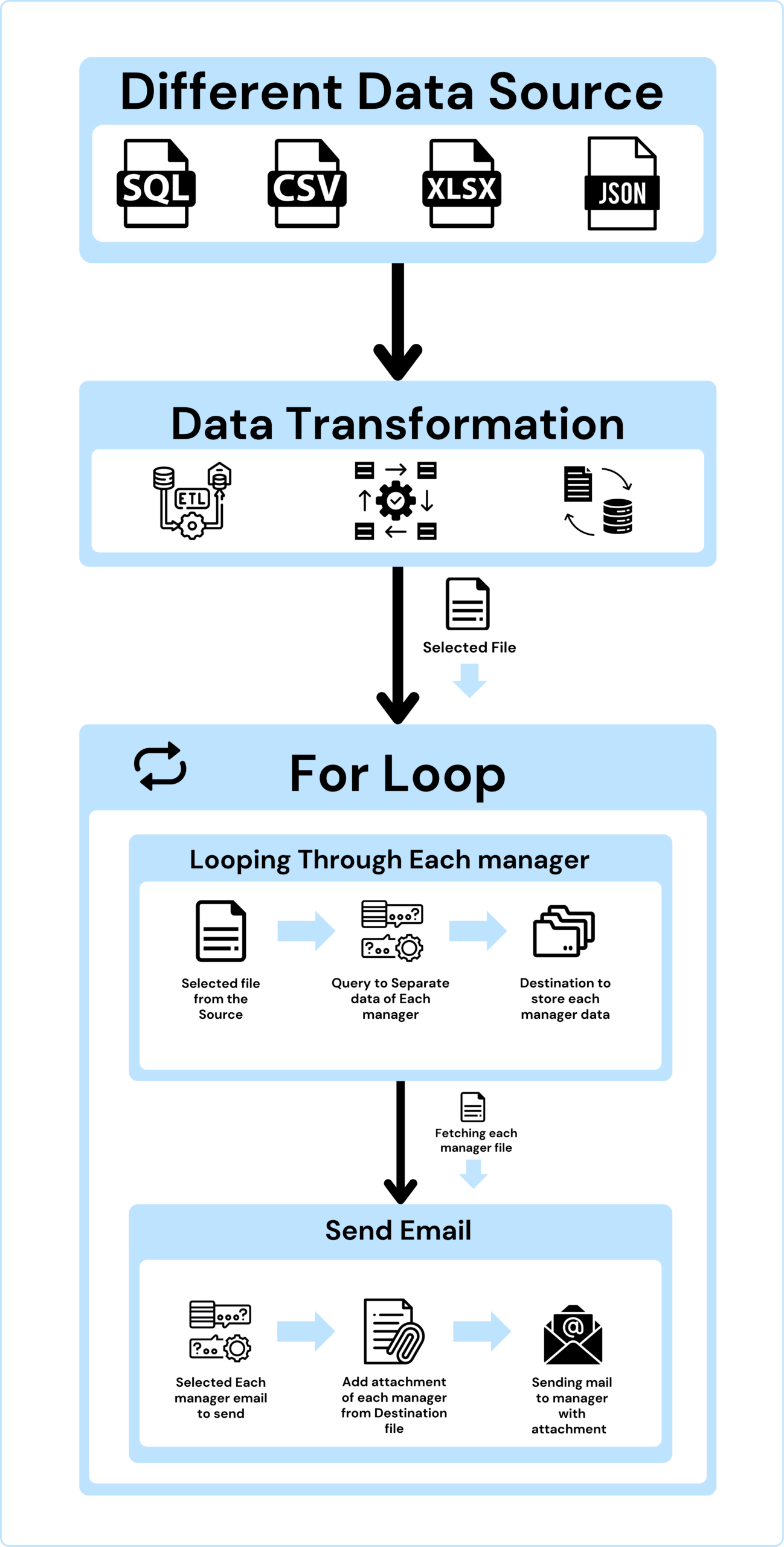
- Data Extraction: The SSIS package was designed to extract data from various sources, including databases, spreadsheets, excel and CSV files. This ensured that all relevant data was consolidated accurately.
- Data Transformation: The extracted data was transformed and formatted according to the specific requirements of the monthly report. The package included necessary data cleansing, aggregation, and calculations to ensure the accuracy and consistency of the final report.
- Email Generation: Once the report was prepared, the SSIS package dynamically generated personalized emails for each manager. The package automatically fetched the manager’s email address and customized the email content to include relevant details.
- Attachment Generation: The SSIS package created an excel or CSV version of the monthly report and attached it to the respective manager’s email. This ensured that the managers received a consistent and standardized report format, regardless of the data sources or formats used.
- Email Delivery: The SSIS package utilized the organization’s email server to send personalized emails with attachments to the respective managers. This automated process eliminated the need for manual intervention and reduced the chances of errors or delays.
Results and Benefits:
The implementation of the SSIS package brought several benefits to the organization:
- Time and Effort Savings: The automation of the data extraction, transformation, and email generation processes significantly reduced the time and effort required to prepare and distribute monthly reports.
- Accuracy and Consistency: By eliminating manual intervention, the SSIS package ensured the accuracy and consistency of the reports, reducing the risk of errors and discrepancies.
- Timely Delivery: The automated email delivery process ensured that each city manager received their monthly report promptly, enabling them to make informed decisions based on up-to-date data.
- Improved Productivity: With the manual reporting process streamlined, employees were able to focus on more value-added tasks, enhancing overall productivity.
Conclusion:
In summary, organizations must employ robust solutions to effectively manage extensive data volumes, ensuring precision and uniformity. Automation is crucial in mitigating risks associated with manual processes, offering comprehensive functionalities such as analysis, duplicate detection, and data validation. By proactively addressing anomalies through client-side validation, data integrity is safeguarded, promoting transparency and informed decision-making. Embracing automated systems and proactive communication optimizes operational efficiency, conserves resources, and furnishes managers with dependable reports, fortifying overall efficacy in data management.